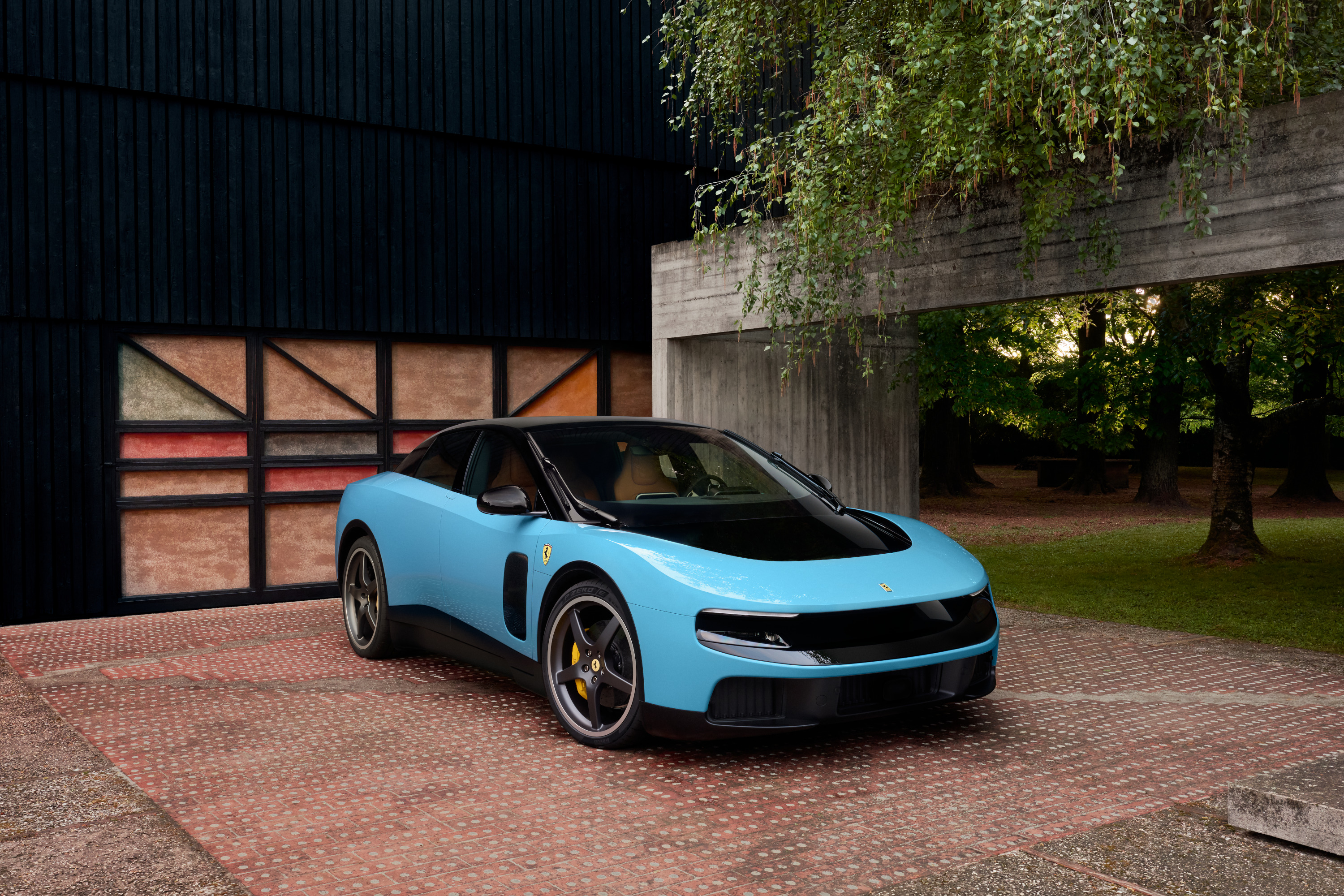

Few brands define performance like Ferrari. To car enthusiasts, the Maranello outfit stands for iconic red paint, gorgeous design lines, and the visceral thrill of high-revving flat-plane crank V8s and soaring naturally aspirated V12s. Naturally, the brand’s die-hard purists were outraged when Ferrari committed sacrilege, by deciding to make an electric vehicle and when they unveiled a new concept that looked like it belonged on a desk next to a mousepad rather than on a racetrack, to say that the online car community exploded with controversy and ridicule would be an understatement.

What is it?
The Ferrari Luce is Maranello’s first fully electric production car, a four-door, five-seat ‘liftback’ created to introduce Ferrari into the electric era. It was expected to be an electrifying moment for the brand, with Ferrari’s legendary engineering, performance and design traditions translated into a silent but immensely powerful grand tourer.
Instead, the unveiling produced one of the most hostile reactions in recent Ferrari history. Enthusiasts had expected an electric Ferrari to look dramatic, exotic and unmistakably Italian. The Luce’s rounded proportions, however, and minimalist appearance led many observers to compare it to a computer mouse, a vacuum cleaner or an enlarged consumer-electronics product. One particularly damaging comparison described it as an Apple mouse on wheels.
The controversy was not caused by a lack of performance. It came from a perceived failure of identity and a historic legacy crafted by exotic Italian Berlinettas and supercars. Ferrari had spent decades developing a visual language associated with long bonnets, aggressive stances, sculpted bodywork and emotional engine-driven proportions. The Luce appeared to replace much of that drama with, according to Ferrari, aerodynamic smoothness and ‘digital minimalism’. For many fans, the car did not look like the future of Ferrari. It looked like Ferrari had betrayed its own roots.
Exterior Design
The Luce is long, low and highly aerodynamic, but its proportions are unlike those of Ferrari’s traditional two-seat sports cars. The cabin is pushed forward, creating a cab-forward silhouette with a relatively short bonnet and a large glasshouse. This layout is partly a consequence of the dedicated electric platform, which allows the battery to occupy the floor and the passenger compartment to extend further toward the front.
The layout more resembles a premium taxi cab rather than an ‘electrifying’ new future.
The front end is unusually smooth. Instead of a large traditional grille, the Luce uses a narrow dark panel with integrated lighting elements. A wide aerodynamic opening is placed near the base of the windscreen, while the nose is shaped to guide air around the body. The lighting is deliberately discreet, disappearing into the dark surface when switched off.
At the rear, the Luce adopts a ‘liftback’ design rather than a conventional saloon boot. Its roof flows into a rounded tail, producing a silhouette that prioritises aerodynamic efficiency and interior practicality. This, unfortunately, did not remind fans of Ferraris of the old like it was supposed to and instead reminded them of a rather bloated Nissan Leaf.
The car’s scale also contributes to the criticism. It is approximately five metres long and weighs around 2,260 kg, making it substantially larger and heavier than the compact mid-engined Ferraris that shaped the brand’s image. The massive wheels, measuring 23 inches at the front and 24 inches at the rear, give the car presence, but they also make the body appear even more substantial.
Ferrari worked with LoveFrom, the design company founded by former Apple design chief Jony Ive, and Marc Newson (which explains its striking resemblance to certain apple products as mentioned before). That partnership helped create a highly controlled and minimalist appearance, but it also intensified the impression that the Luce had been designed as a technological object rather than an sensual and raw automobiles, as all Ferraris are supposed to be.

Interior Design
The interior is considerably more successful than the exterior. Rather than continuing the rounded and somewhat anonymous appearance of the bodywork, the cabin combines modern technology with carefully chosen physical materials which successfully carries out a return to Ferrari’s iconic past.
The seats use glass and aluminium structures beneath rich leather coverings, creating a balance between lightweight engineering and luxury. A roof-mounted panel contains aluminium toggle switches for functions such as the lights and launch control. These details provide a tactile quality that prevents the cabin from becoming entirely dependent on touchscreens. The instrument display uses digital graphics layered with physical-style needles, creating a visual connection with traditional Ferrari instrumentation. The steering wheel also uses conventional switches rather than the touch-sensitive controls criticised in some recent Ferraris. Two separate manettino controls are provided, one for the vehicle’s dynamic systems and another for the electric powertrain.
The interior therefore reveals a more coherent design philosophy than the exterior as it gives the Luce a sense of quality.

Performance Specifications
Although it doesn’t show, the Luce’s technical numbers are extraordinary. It uses four electric motors, one for each wheel, with a total output of approximately 1,035 to 1,050 horsepower. Ferrari claims a 0–62 mph time of 2.5 seconds and a top speed of approximately 192 mph. The battery has a capacity of 122 kWh, operates on an 800-volt architecture and supports charging at up to 350 kW. Ferrari estimates a range of approximately 330 miles, or 530 kilometres, depending on the testing standard used.
The four-motor layout enables sophisticated torque vectoring across both axles. Ferrari has also equipped the car with active suspension, four-wheel steering and advanced electronic systems intended to manage the Luce’s considerable weight. Its front axle produces 210 kW and is claimed to achieve 93 percent efficiency, while the electric motors are derived from technology developed for Ferrari’s high-performance hybrid programmes.
These figures establish the Luce as a genuine Ferrari in terms of acceleration and engineering ambition. However, they also reveal the central tension within the car. More than 1,000 horsepower and a 122 kWh battery create spectacular performance, but the resulting weight makes it difficult for the Luce to communicate the lightness and delicacy associated with Ferrari’s finest sports cars which are often said to be ‘silky’ and ‘balletic’.

What Went Wrong?
The Luce appears to have suffered from a mismatch between technical ambition and emotional expectation. Ferrari treated its first electric model as a new category of vehicle, but many customers expected the car to remain visibly connected to the brand’s most admired forms.
The decision to prioritise a forward cabin, smooth aerodynamic surfaces and minimalist technology produced an efficient and spacious vehicle. It also removed several features that traditionally communicate speed before the car even moves. The long bonnet became shorter, the side surfaces became smoother, the exhaust disappeared and the sophisticated mechanical appearance of a conventional Ferrari was replaced by a clean electric shape.

The involvement of designers associated with consumer technology also affected public perception. The Luce’s interior benefits from the partnership, but the exterior’s smoothness encouraged comparisons with phones, computer mice and household appliances. That comparison is particularly damaging for Ferrari because the brand sells emotional experiences as much as transportation.
The car’s launch also created a financial and reputational problem. Negative reactions from fans, analysts and former Ferrari figures were followed by a fall in Ferrari’s share price. Former Ferrari chairman Luca di Montezemolo criticised the appearance so strongly that he questioned whether the car should wear the famous prancing horse badge. Ferrari’s chief executive Benedetto Vigna has since defended the design, stating that the company would not change anything about the launch.
The irony is that the Luce may become more convincing once it is driven. Its performance, engineering and interior quality appear to be genuinely impressive, and some reviewers have reported that the design is more effective in person than in photographs. Nevertheless, first impressions matter greatly at the luxury end of the market. The Luce’s central problem is not that it is electric, but that it does not immediately look like the Ferrari many customers wanted an electric Ferrari to become.
This reveals two points of view, a section of the Ferrari fanbase who know and accept that electrification is the way to go and another section who did not like the idea of a fully electrified Ferrari just yet and were even more infuriated when Ferrari launched something like the Luce.
Lamborghini’s Close Call and Ferrari’s Redemption Gambit
Ferrari’s reception caused Lamborghini to subsequently abandon its planned purely electric Lanzador and electric Urus projects, choosing instead to concentrate on plug-in hybrid powertrains. Lamborghini chief executive Stephan Winkelmann said that the decision reflected weak acceptance of fully electric vehicles among the company’s customers and described the shift as the correct choice for Lamborghini. It seems clear that he did not want his company to meet the same grim fortune that Ferrari did.
Ferrari also attempted to reinforce its traditional identity with the limited-production 12Cilindri Manuale. The car uses Ferrari’s naturally aspirated V12 and provides an open-gate six-speed shift pattern with a clutch pedal, apparently reviving the classic manual experience. However, it is not a conventional mechanical manual gearbox. The system is manual by wire, meaning there is no traditional physical connection between the clutch, gear lever and transmission. It retains an eight-speed dual-clutch gearbox, which can also operate automatically, while software and actuators reproduce the action of a manual transmission. Fool’s Gold, one might say.

In summary, the Luce may be technically exceptional, but its reception shows that Ferrari customers are not only buying speed, luxury or engineering. They are buying an image, a sound and an emotional connection that the first electric Ferrari has struggled to communicate.
News Courtesy:
– Top Gear
– Car and Driver
– MotorTrend
– CNBC
– Ferrari
Image Courtesy:
Ferrari
Leave a Reply