
What is it?
It is PURE. SIMPLE. FUN.
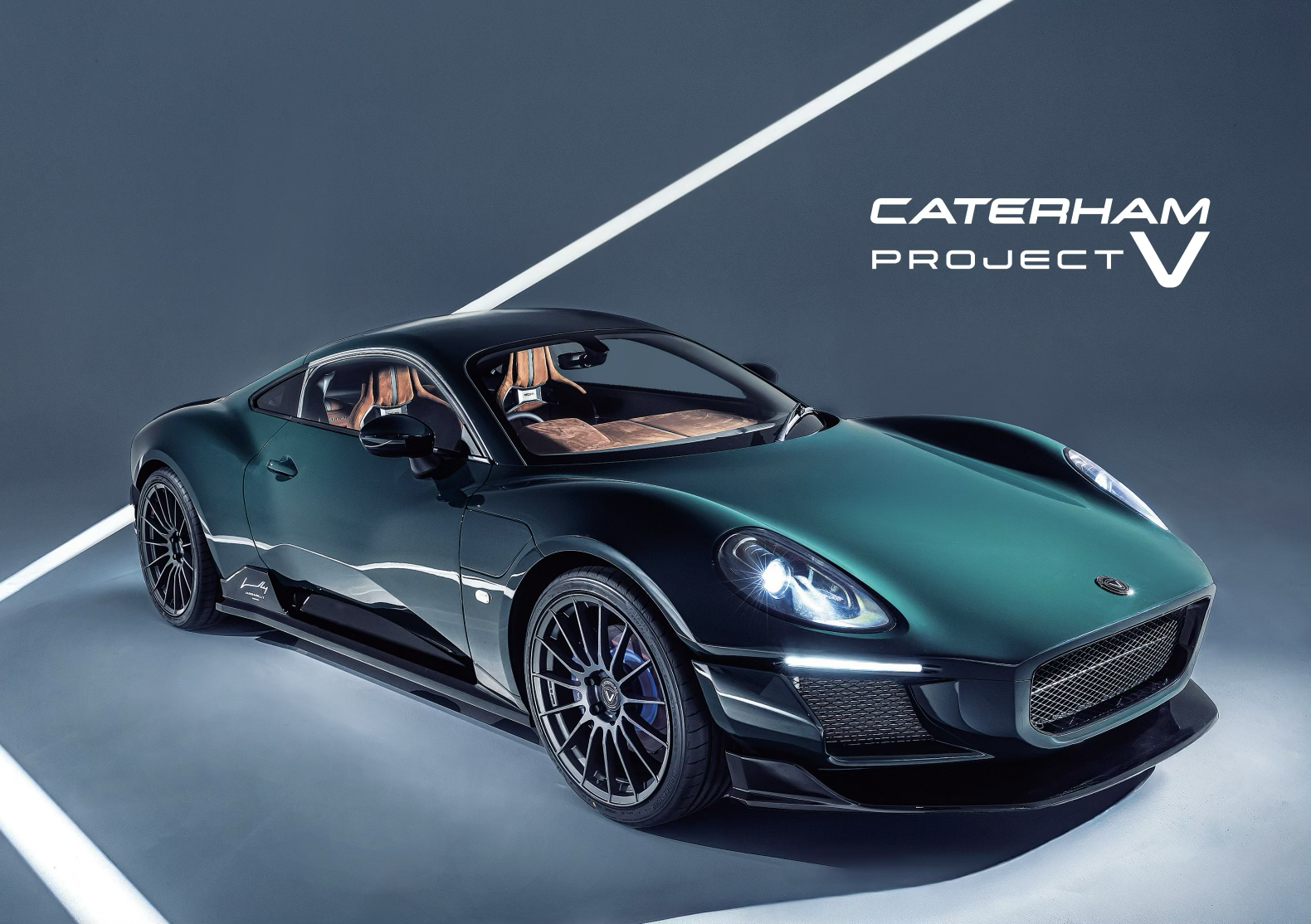
The Caterham Project V is an electric sports coupé designed around a simple but increasingly important idea: performance does not require enormous power, massive batteries or excessive weight. Instead of attempting to compete with electric hypercars through extreme acceleration figures, Project V applies Caterham’s traditional principles of lightness, simplicity and driver involvement to the sports car of the future.
The result is a compact, rear-wheel-drive coupé with a single rear-mounted electric motor, a 47 kWh battery and a target output of 268 bhp. Caterham quotes a projected 0–62 mph time of less than five seconds, a top speed of 143 mph and a WLTP range of approximately 249 miles. The current target weight is 1,430 kg, which remains considerably lighter than many modern electric performance cars, although the final specification may change as development continues.
Project V is not intended to be the fastest electric car in the world. Its purpose is more fundamental. It aims to demonstrate that an electric sports car can remain small, responsive and emotionally engaging rather than becoming a heavy grand tourer with sports-car styling. In that sense, it represents an evolution of the Caterham Seven rather than a complete departure from it.
Heritage, Origins and Design Philosophy
Caterham’s identity has always been based on the idea that a lighter car can provide a more rewarding driving experience than a heavier car with greater power. The company’s connection to the Lotus Seven established a philosophy centred on mechanical simplicity, low mass and direct communication between driver and road.
Project V transfers that philosophy into an electric vehicle. Caterham describes the car as its vision of the near future, viewed through the lens of the Seven. The objective is not to reproduce the exposed, minimalist architecture of the Seven, but to preserve the thinking behind it. Every component must justify its presence, and unnecessary weight must be avoided wherever possible.
The project began in September 2022, when designer Anthony Jannarelly started work with Caterham on an all-new electric sports coupé. Italdesign was later commissioned to build the original show car, which was unveiled at the 2023 Goodwood Festival of Speed. Since then, Project V has appeared at international events including the Tokyo Auto Salon, Turin Auto Show, IAA Mobility in Munich and CES in Las Vegas.
Yamaha later joined the project as a development partner, providing electric axle technology for the latest prototype. XING Mobility is involved in the battery system, while Panasonic Energy supplies the cylindrical battery cells. The car is therefore a British-led project supported by specialist international partners, with each company contributing to the objective of creating a compact and responsive electric sports car.

Performance Specifications
Project V’s headline figures are intentionally modest by modern electric-car standards, but they are carefully matched to the car’s intended character.
| Specification | Caterham Project V |
| Powertrain | Single electric motor (RWD) |
| Maximum output | 268 bhp / 200 kW / 272 PS |
| Battery | 47 kWh |
| Vehicle Weight | 1,430 kg |
| 0–62 mph | < 5.0s |
| Top speed | 230 km/h |
| WLTP range | 400 km |
| Charging | 20-80% SOC ~ 20 minutes |
| Suspension | Double wishbone front and rear |
The relatively small battery is central to the Project V concept. A smaller pack reduces mass, occupies less space and avoids the need to carry hundreds of additional kilograms merely to achieve a very long range. Caterham is targeting approximately 249 miles, which should be sufficient for normal road use while keeping the car focused on agility rather than long-distance luxury.
The estimated 0–62 mph time of under five seconds is quick without being excessive. It should allow the car to feel energetic on the road while leaving room for the driver to explore its handling at legal and track-day speeds. Project V therefore prioritises the quality of acceleration, cornering and braking rather than acceleration figures designed mainly for publicity.

Powertrain and Battery Technology
The Project V uses a rear-mounted Yamaha single-motor e-axle, sending power exclusively to the rear wheels. This configuration gives the car a clear dynamic identity. Rather than distributing power between multiple motors, Caterham has chosen a simpler arrangement that should make the car feel more predictable and adjustable through the throttle.
The 47 kWh battery uses XING Mobility’s immersion-cooling technology. The battery cells are immersed in a cooling fluid, allowing heat to be managed more effectively during demanding driving. This is particularly important in a lightweight sports car, where repeated acceleration, braking and cornering can place considerable thermal demands on the battery and motor.

Caterham quotes a 20 to 80 percent charging time of approximately 20 minutes using a 100 kW DC fast charger. The charging figure is not intended to turn Project V into a long-distance motorway vehicle. Instead, it provides enough flexibility for road trips and track-day use without requiring an oversized battery. The philosophy remains consistent throughout the car: use technology intelligently, but do not allow it to overwhelm the vehicle.
Chassis, Suspension and Handling
Project V’s most important specification may not be its power output, but its chassis layout. The car uses double-wishbone suspension at both the front and rear, a configuration that allows engineers greater control over wheel movement, geometry and tyre contact than simpler suspension designs.
The front and rear suspension arrangements are intended to preserve steering accuracy and cornering stability while allowing the chassis to remain communicative. With a relatively short wheelbase of 2,630 mm, a low height of 1,230 mm and a rear-wheel-drive layout, Project V should feel compact and responsive rather than isolated from the driver.
The tyre arrangement also reflects the car’s performance priorities. Project V uses 235-section front tyres and wider 285-section rear tyres, with 19-inch wheels at the front and 20-inch wheels at the rear. This provides the rear axle with the traction required for electric torque while maintaining a sharp front end.
The stated weight of 1,430 kg is not exceptionally low compared with the earliest Project V targets, but it remains significant for a modern battery-electric sports car. Earlier development discussions suggested a figure closer to 1,190 kg, while the current Caterham website lists 1,430 kg as the latest target specification. The change demonstrates the difficulty of developing a production-ready electric car while retaining the simplicity and lightness of a concept.

Exterior Design
Project V’s exterior design is a modern interpretation of the classic lightweight coupé. It avoids the visual bulk associated with many high-performance electric cars and instead uses a low roofline, compact body and flowing aerodynamic surfaces.
The front end is clean and purposeful, with slim lighting elements and a rounded nose that gives the car a sense of movement even when stationary. The proportions are closer to those of a lightweight European sports car than a conventional electric grand tourer. A long, smooth bonnet, compact cabin and short rear section create a balanced silhouette without relying on excessive vents, wings or sharp creases.

The design was created to be timeless rather than aggressively futuristic. Its shape does not depend on temporary styling trends, and each major feature appears to serve either an aerodynamic or structural purpose. This corresponds closely with Anthony Jannarelly’s design principle that every feature must justify itself in terms of weight and driver engagement.
Project V also has a compact 2+1 seating arrangement, making it more practical than a strict two-seat sports car without compromising its proportions. The additional central rear seat is not intended to transform the Caterham into a family vehicle, but it provides occasional flexibility for short journeys or additional luggage.

Interior and Driver Experience
The interior follows the same restrained philosophy as the exterior. Instead of surrounding the driver with screens and decorative technology, Project V places emphasis on visibility, seating position and the physical relationship between the controls and the driver.
The low seating position is intended to create a stronger sense of connection with the road. The cabin is compact but not deliberately austere, and the coupé body provides a more refined environment than the open Seven. The design balances lightweight construction with enough comfort for the car to be used on ordinary roads.
The steering wheel, instrumentation and central controls are arranged around the driver, reinforcing the car’s sporting purpose. As with the exterior, the interior does not attempt to disguise the vehicle’s engineering identity beneath excessive ornamentation. Its appeal comes from proportion, material restraint and the expectation that the driver, rather than the software, will remain the centre of the experience.

A Rival in the – The Alpine A110 Future
The closest conceptual rival to Project V may be the Alpine A110 Future. Both cars are attempting to solve the same problem: how to create an electric sports car that remains light, agile and attractive in a market where battery vehicles are becoming increasingly heavy.
Alpine’s A110 Future uses a dedicated platform, dual 800-volt cell-to-pack batteries and a dual-motor powertrain. Its Alpine Dynamic Module is designed to coordinate the powertrain, chassis and aerodynamics, while active torque vectoring can redistribute torque between the rear wheels every 10 milliseconds. Alpine’s stated objective is to preserve the instinctive handling and lightness associated with the A110 while introducing much greater electric performance.
The two cars approach the challenge from different directions. Project V is smaller, simpler and rear-wheel drive, with a single motor, a 47 kWh battery and Caterham’s traditional focus on low mass. The A110 Future is technically more ambitious, using two motors, 800-volt technology and sophisticated electronic control systems to maintain agility despite the additional complexity.
Their competition will therefore be philosophical as much as commercial. Project V argues that an electric sports car should remain mechanically simple and modestly powered, while Alpine is attempting to use advanced electronic systems to recreate the delicacy of a lightweight petrol sports car. Both recognise that electric performance cannot be defined by acceleration alone. Weight, balance, steering response and driver confidence may become the most important measures of success.
Production and the Future
Project V remains a development programme, and Caterham states clearly that its published figures are target specifications subject to change. The car has progressed beyond a static design study through the involvement of Yamaha, XING Mobility and the development of functional prototypes, but final production timing, pricing and equipment have not been confirmed by the company.
If Caterham succeeds in bringing Project V to production close to its current objectives, the car could become one of the clearest arguments against the assumption that every electric performance vehicle must be large, powerful and heavy. It would not attempt to overwhelm the road with numbers. Instead, it would pursue the qualities that made lightweight sports cars compelling in the first place: low mass, direct responses, balanced handling and the feeling that every component exists for a reason.
News Courtesy: Caterham Cars + Alpine Cars
Image Courtesy: Caterham Cars + Alpine Cars
Leave a Reply