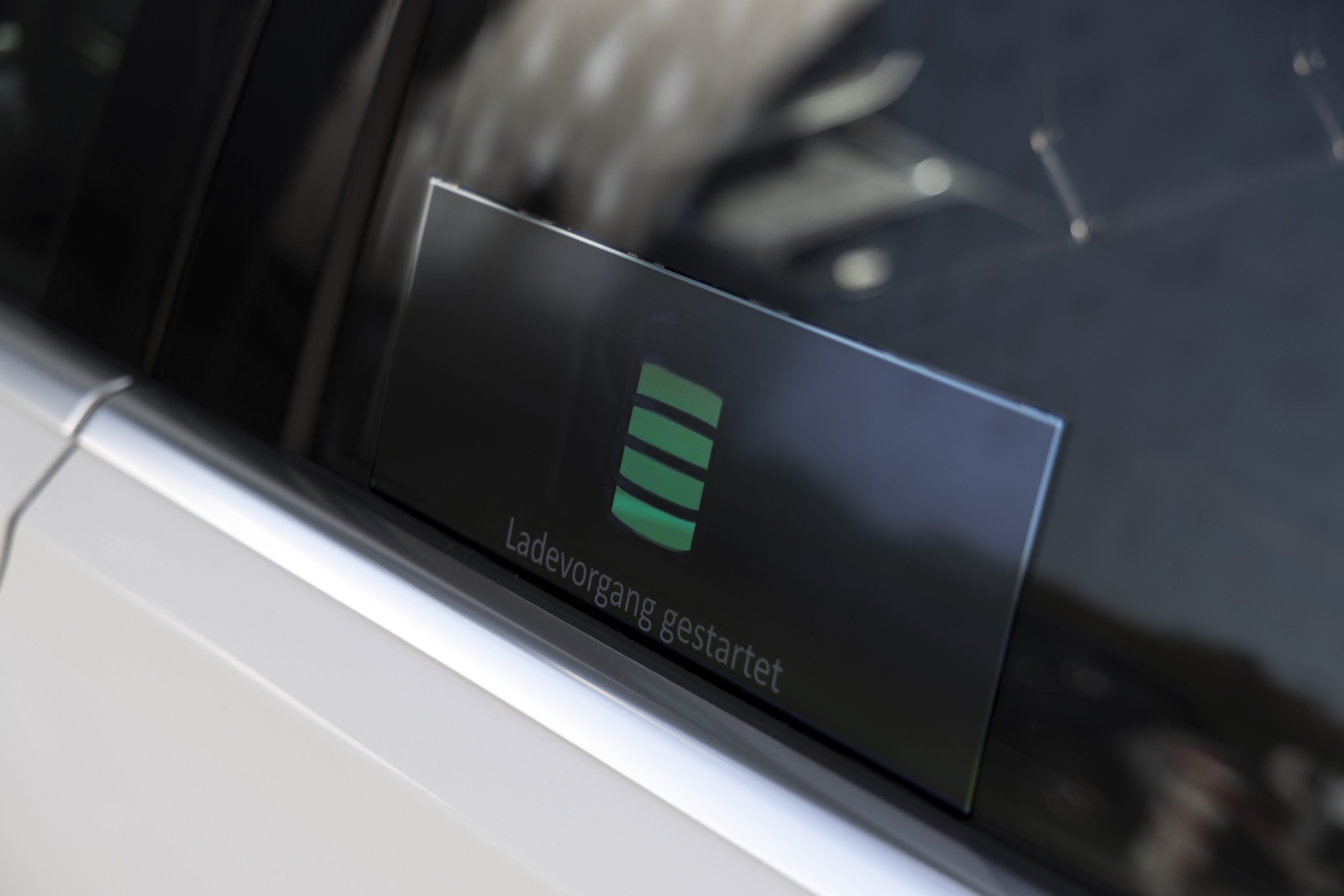

Mercedes-Benz has given a look at three technologies it is currently developing for future vehicles. The most important for electric cars is a new high-voltage Power Converter that manages energy at the level of individual battery cells. Alongside it, the company showed two new display concepts: LED elements built directly into the car’s windows and a holographic display on the windscreen.
What is it?
In a conventional EV battery, the cells are connected in series to reach the required high voltage, so the pack is only as good as its weakest cell. Mercedes-Benz’s Power Converter takes a different approach. Programmable micro-converters regulate the flow of energy at the individual cell level and deliver a stable high-voltage output of up to 800 volts, regardless of each cell’s state of charge or age.
The current generation delivers up to 3 kW and supports both AC and DC applications, including AC charging. Several converters can be run in parallel to scale up the total power, which means the high-voltage output no longer depends on how many cells are connected in series. In future, the technology is set to handle AC/DC conversion and bidirectional charging such as Vehicle-to-Home (V2H) and Vehicle-to-Grid (V2G).
| Power Converter | Details |
|---|---|
| Control level | Individual battery cell |
| Output voltage | Stable, up to 800 V |
| Power (current generation) | Up to 3 kW per unit, scalable in parallel |
| Applications today | AC and DC, including AC charging |
| Planned | AC/DC conversion, V2H and V2G |
| Target vehicles | Battery-electric and plug-in hybrid |
Why it matters for EVs
Because the converters can take over tasks that today need separate components, several vehicle functions could be merged into a single hardware unit. Mercedes-Benz expects this to improve range and efficiency and to make modular powertrains easier to build for both battery-electric vehicles and plug-in hybrids. Managing cells individually could also let a battery make better use of cells that have aged differently, a growing topic as the first generations of EVs get older.
Displays in the glass
The Intelligent Display in Glass lets the car communicate with other road users through LED elements laminated into the windows, which are almost invisible when switched off. Mini LEDs suit larger areas such as the rear window and could show brake lights, warning symbols or traffic information for following drivers, while higher-resolution Micro LEDs can show more detailed graphics and animations on smaller areas. The side windows could display personalised information such as the weather, charging status, messages or a digital parking disc.

The Holo Display turns the windscreen into an on-demand screen. A projector in the instrument panel casts content onto a transparent film with holographic optical elements laminated into the glass. The image stays visible even in direct sunlight and can only be seen from certain angles, so the driver and front passenger each see their own content, from navigation and driving information to video calls and films.

“The future of mobility is not created through promises, but through precision and proven engineering excellence.”
Ida Wolf, Vice President Development Innovations, Operations & Digitalisation, Mercedes-Benz AG
All three technologies are still in development and not yet ready for series production, and Mercedes-Benz has not given a timeline for when they will reach customers.
News Courtesy: Mercedes-Benz Group AG
Image Courtesy: Mercedes-Benz Group AG
Leave a Reply