
The Audi e-tron GT quattro has been the electric and sporty top model in Audi’s product portfolio since its premiere in 2021. The four-door Gran Turismo combines evocative design with a powerful drive system and dynamic handling. The new versions significantly improve the sporty vehicle’s range, performance, charging, and handling. With the RS e-tron GT performance3, Audi is debuting its first fully electric RS performance model. The new models in the Audi e-tron GT family are available to order now.
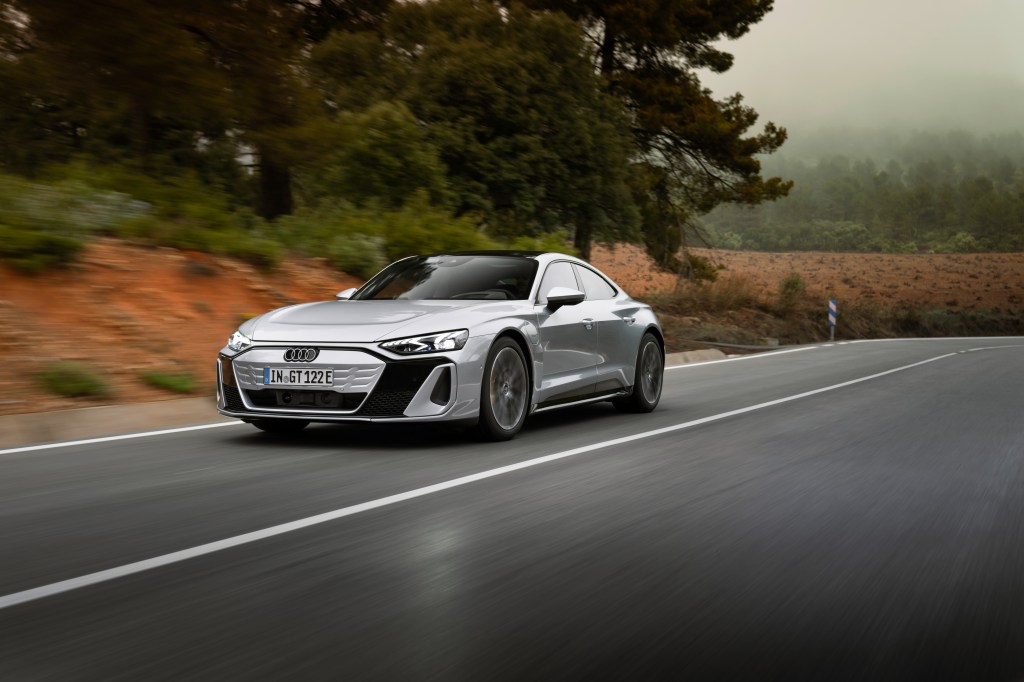
‘With the e-tron GT models, we are setting new standards in performance. The increased charging power and electric all-wheel drive ensure improved long-distance capability and considerably more performance. The newly developed chassis offers an unprecedented range between driving comfort, ride comfort, and driving dynamics,’ says Gernot Döllner, Chairman of the Board of Management of AUDI AG.
The new variants of the e-tron GT series combine a progressive design with innovative technology, each having a distinctive look. For example, the new Audi S e-tron GT1 stands for elegant sportiness. Its front end is homogeneous and expressive at the same time. A black mask encircles the fully closed, inverted Singleframe, which reflects the specific design language of the e-tron models. Embossed structures lend the grille a precise three‑dimensionality. A strip of body‑color paint above the Singleframe gives the Gran Turismo an even sportier and visually deeper look. The air curtains, which ensure optimized airflow around the front wheel in the front apron, are more strongly shaped. An elegantly designed aerodynamic diffuser with vertical fins dominates the rear end. A body‑color inlay above the rear diffuser adds even more visual texture and acts as a link between the diffuser and rear bumper.
The Audi RS e-tron GT performance3 is the first fully electric RS performance model. It features unique design elements and stands out from the RS e-tron GT2 with an optional matte, darkened carbon roof in combination with optional carbon camouflage elements. These elements are a first from Audi and are intended exclusively for the RS performance. The carbon camouflage is used in the embossed bumper structures, the door trim, parts of the diffuser, and the side mirrors.
The interior: Sporty elements and sustainable materials, Upgraded Audi virtual cockpit and smart panoramic roof
Audi’s new CI also shapes the interior with redesigned seats, steering wheel, entry sills, and digital content. The light projection from the door has also been adapted. When the driver’s door opens, a red diamond with a red shadow appears; the S version features a white diamond with a red shadow. New wooden inlays in natural linear anthracite birch are available for the e-tron GT family; for the RS e-tron GT performance3, they are also available in matte carbon camouflage to match the exterior. New interior features include applications in Vanadium, an anthracite-colored effect finish that appears differently depending on the lighting. The applications are available as an option for the S e-tron GT1 and come as standard in the RS models.

Sunroof 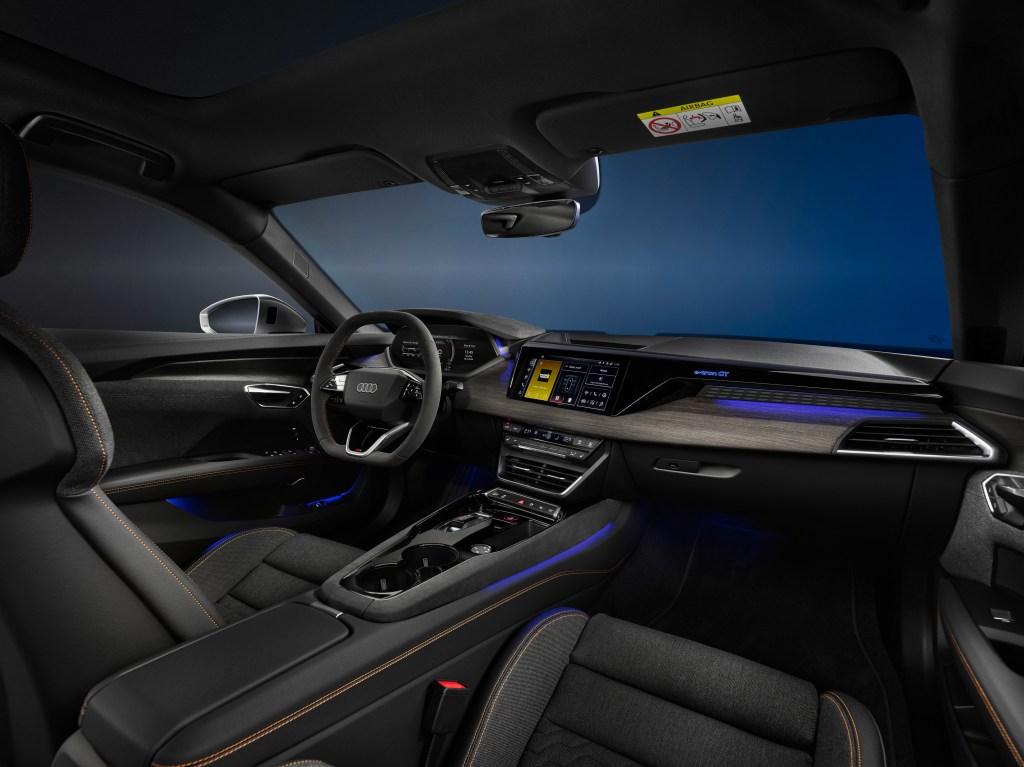
Interior 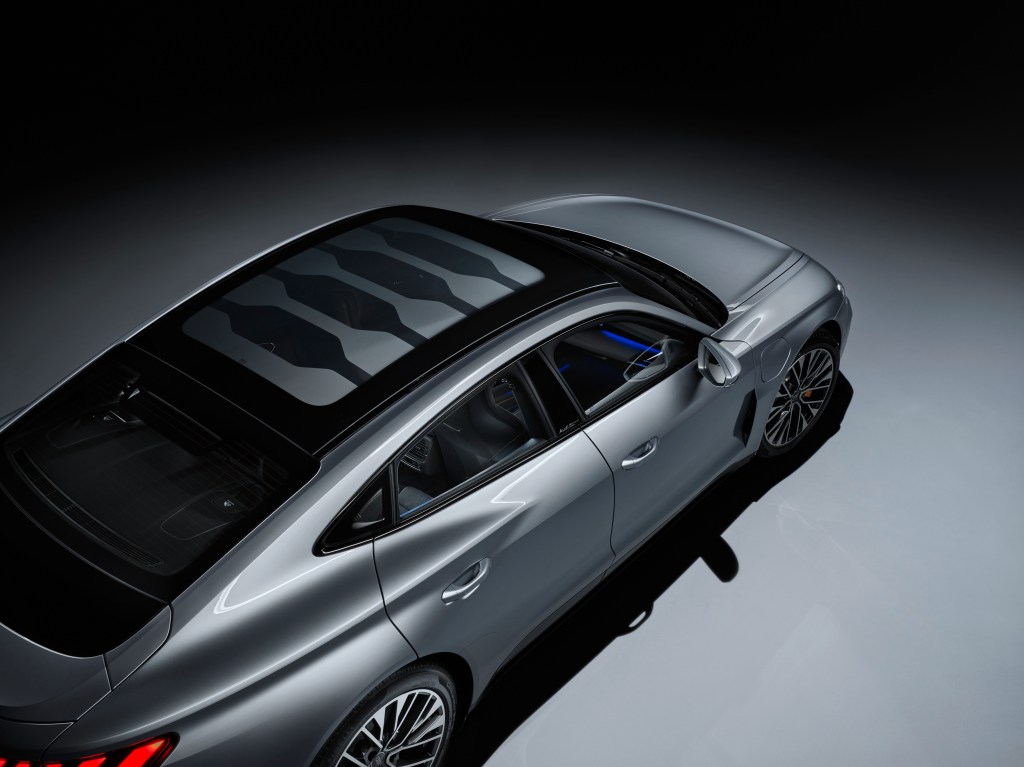
Audi S e-tron GT from Top
The GT family is digital and connected thanks to numerous Audi Connect services, on-demand functions, and an app store. The Audi virtual cockpit provides new information on the battery temperature and shows the maximum possible charging power in real time. The RS e-tron GT2 features displays with RS-specific content. For example, customers who purchase an RS e-tron GT performance3 can select a white power display and speedometer via the MMI – a tribute to the 1994 Audi RS 2 Avant, where the analog dials initially came in white.
More efficient and powerful: Electric all-wheel drive, Lighter battery with higher energy density, range up to 609 km**, Higher charging power: Charge for 10 minutes, drive 280 kilometers
Permanent-magnet synchronous motor (PSM) are used as electric motors on the front axle of the S e-tron GT1 and the RS e-tron GT2 and have an output of 176 kW (239 PS) each. As an additional feature, the RS e-tron GT performance3 has modified power electronics on the front axle with a revised pulse inverter for even higher discharge currents. All three derivatives are more efficient, while also boasting significant increases in power and improved acceleration.
The newly developed electric motor on the rear axle, also a permanent-magnet synchronous motor (PSM). It is the same size as the PSM in the RS e-tron GT2 and RS e-tron GT performance3 at an axial length of 192 millimeters and a diameter of 230 millimeters. Parts like the motor come from the Premium Platform Electric (PPE). The electric motors have an output of 415 kW (564 PS) each. Both electric motors have power reserves for extreme driving situations. The maximum total output of the drive system in the S e-tron GT1 is 500 kW (679 PS). The RS e-tron GT2 reaches a maximum electric output of 630 kW (856 PS). The RS e-tron GT performance3 delivers an output of 680 kW (925 PS). This makes it the most powerful production car that Audi has ever built.

Liquid cooled lithium-ion battery 
Cooling of the HV battery
Audi has lowered the weight of the high-voltage (HV) battery while simultaneously increasing its energy density. Despite the higher energy content, the weight of the HV battery has been reduced by nine kilograms to a total of 625 kilograms. The HV battery boasts a gross storage capacity of 105 kWh (net: 97 kWh). Among other measures, optimizing the two-layer cooling plate results in a twelve percent increase in capacity for the 33 cell modules, each holding twelve pouch cells with a flexible outer skin. Audi has also modified the cooling system of the cells themselves.
Audi has increased the maximum charging power by 50 kW to 320 kW. Under ideal conditions, the e-tron GT family’s HV battery can charge from 10 to 80 percent in only 18 minutes at a high-power charging (HPC) station. In as fast as 10 minutes, the battery recharges to a range of up to 280 kilometers. Outfitted with Plug&Charge, the vehicle automatically authorizes and activates compatible charging stations when the charging cable is plugged in. The new HV battery also features a significantly wider quick-charging window. Even in low temperatures, the car reaches very high charging performance faster. This enables very high charging performance at temperatures as low as 15 °C, further reducing the energy requirements of the thermal management system and making it even easier for customers to take advantage of the ideal quick-charging window. As an option, customers can also charge with up to 22 kW when charging with alternating current.
Active suspension and Audi drive select with individually configurable RS modes
The standard suspension is a newly developed air suspension with 2-chamber/2-valve technology, which offers significant advantages in driving dynamics without compromising on comfort. The new and highly innovative active suspension is also available as an option. This system provides an unprecedented spread between comfort and driving dynamics.
The Audi drive select dynamic handling system lets the driver control the vehicle’s character. It features three profiles: efficiency, comfort, and dynamic. The S e-tron GT1 also enables the driver to configure an individual mode, and the RS models offer two individually configurable, RS‑specific modes: RS1 and RS2. As an exclusive feature, the RS e-tron GT performance3 has a performance mode designed for an optimal setup on challenging circuits.

Available to order now, prices start at 126,000 euros
The new models of the Audi e-tron GT family are available to order now. Prices for the S e-tron GT1 start at 126,000 euros, the RS e-tron GT2 at 147,500 euros, and the RS e-tron GT performance3 at 160,500 euros.
**under ideal conditions
1. Audi S e-tron GT: Combined electric power consumption in kWh/100 km (62.1 mi): 19.7 –18.0 (WLTP); combined CO2 emissions in g/km (g/mi): 0; CO2 class: A
2. Audi RS e-tron GT: Combined electric power consumption in kWh/100 km (62.1 mi): 21.1 –18.4 (WLTP); combined CO2 emissions in g/km (g/mi): 0; CO2 class: A
3. Audi RS e-tron GT performance: Combined electric power consumption in kWh/100 km (62.1 mi): 20.8 –18.7 (WLTP); combined CO2 emissions in g/km (g/mi): 0; CO2 class: A
Image and News Courtesy: Audi MediaCenter




 EV Cartel
Leave a comment