
Swiss deep-tech company WayRay has unveiled the world’s first car with ground-breaking holographic AR glazing. Christened the WayRay Holograktor car, the 4.4-meter battery-electric vehicle has been designed to highlight its True AR™ holographic displays in a coming of age for the deep-tech firm. The three-seat Holograktor has been conceived as a ride-hailing car and can either be driven conventionally or by remote control via a 5G and satellite internet connection to a qualified driver. While it is being evaluated for production feasibility, the concept car has been built to highlight the maturing of the breakthrough holographic technology from WayRay. Taking up a tenth of the in-dash space of a conventional HUD, the WayRay True AR® holographic displays also deliver crucial upgrades in distance to virtual content, color saturation and accuracy. Currently WayRay is the only +company in the industry capable of designing and manufacturing complex Deep Reality Displays based on Deep Reality Display® technology, as well as rendering the content realtime around the car using a proprietary True AR™ Rendering Engine software. Backed by early investments from companies like Porsche, Hyundai and Alibaba, WayRay is using the Holograktor car to emerge from its “Deep Tech” automotive supplier status into the world of new mobility models.

The Holograktor (Photo: WayRay)“We see that we have zero competition in that type of displays, and it is clear that we will capture the biggest market share,” WayRay founder Vitaly Ponomarev said. “We will demonstrate that we don’t want to just be a supplier to the industry, but the technology leader in holography in general, particularly in automotive.”
WayRay Holograktor
The WayRay Holograktor car is not only the first car designed around True AR™ technology, but it is also the first car designed around a new ride-hailing business model. It is the first car in history, WayRay founder Vitaly Ponomarev said, to be designed around content consumption and interaction, as well as holographic glazing.
“This is a car designed specifically for zoomers and it’s for people who want to play and want to create and consume content,” Ponomarev said. Its unusual single rear seat “throne” layout was inspired by data showing that more than 80 percent of Uber trips were for one person only. “The idea is that you can choose Uber Black, Uber SUV or Uber Holograktor, and if you choose the Holograktor, your ride will be subsidized by sponsored content, so the price will be much lower,” Ponomarev added. “That is the concept.”
Even so, the Holograktor concept car cuts no corners and has been engineered and designed from the first drawings to be developed into a production reality. The Holograktor car stacks its 2,880 mm wheelbase with cutting-edge battery technology to deliver an estimated range of 600 km. Conceived as a ride-hailing car, its acceleration times are less important than its comfort and technical prowess. Nonetheless, it can still reach 100 km/h in 3.9 seconds thanks to the strength of its single electric motor, with its top speed being limited to 200 km/h. At 4,416 mm long, the Holograktor is shorter than a typical compact SUV but far larger inside. The entire car was also designed to showcase the True AR™ holographic technology from WayRay, and each passenger will have access to several holographic Deep Reality Display® HUDs in front and on the side, with each seat being fitted with joysticks for gaming and to interact with the content. “None of the OEMs have designed that so far, so it’s very radical.”
WayRay Holograktor Interior Design
Its interior has been designed around a novel 2+1 seating arrangement, with the front seats pushed wide apart to provide all three occupants with a clear view of holographic displays. To accommodate for ride-hailing, all of the glazing in the WayRay Holograktor car is engineered around True AR™ technology. That concept helps take the Holograktor out to 2,023 mm wide (or 2,029 mm including its digital side-mirror cameras). It sits at 1,582 mm in height, with the Shrimp feature at the rear of the roof designed to draw attention to the breakthrough technology inside. “My ambition is to release this car four years from now and make it homologated,” Ponomarev said. “That depends very much on the perception of the market. “It could be, though, that we just use it as a white label concept to help other OEMs to make cars like this with our True AR™ technology.”
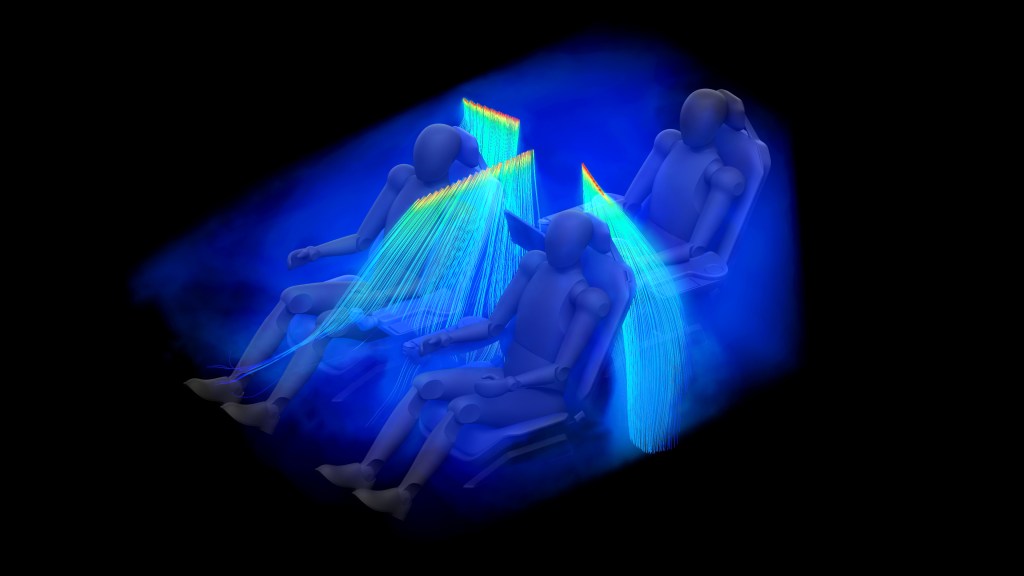
"The Shrimp" concept visualized (Photo: WayRay)The Holograktor car was designed by renowned hypercar designer Sasha Selipanov in collaboration with WayRay’s in-house team of designers. “The True AR™ holography was the main driver for the entire design. Every feature and design theme is driven by AR holography, including the Shrimp,” said Selipanov. “The occupant in the back must look out of the windshield, which is why the driver and the passenger in the front seats are spaced out as much as possible. “We have 500 mm between the center of the driver’s seat the centerline of the car, which is about 100-150 mm more per side than any normal passenger car would have. The driver and the passenger are spaced out further so whoever is in the back gets a fair view of the windshield and its True AR™ functionality.” Another string to the WayRay Holograktor car’s technical suite is its ability to be driven remotely, by a qualified driver using the car’s cameras, radar, mapping and sensor suites, leaving the passengers to relax without relying on immature autonomous-driving systems. That left the question of what to do with the steering wheel, which WayRay solved by sliding it forwards and simply fitting it into a groove in the dashboard. “We have seen a few innovative concepts of how steering wheels can fold away out of view, but we didn’t want to come up with something ridiculous just for the sake of it,” Selipanov said. “When it’s disengaged, the steering wheel slides into the dashboard and becomes almost seamless with the rest of the interior. “The reason is simple: ultimately there will be an airbag there, and the airbag should remain deployable. “Safety is first and foremost, and that brings with it a certain sense of realism. We always had a production car as our goal.”
WayRay Holograktor Exterior Design
At the core of the WayRay Holograktor car’s design was the challenge of combining the concept car’s enormous interior space with a well-proportioned exterior, all while staying in line with all current and approaching regulations. Beyond that, the strong triangular shapes and solid stance are a nod to the Russian backgrounds of WayRay founder Vitaly Ponomarev and car designer Sasha Selipanov. “We right away zeroed in on this Russian constructivism form language,” Selipanov said. “If you have those early Soviet posters in mind, you can see those brightly colored geometric shapes of triangles and blocks.“We wanted to create a visual language for WayRay that took Russian constructivism as the base. Coincidentally, the triangular form is reminiscent of a prism, like the Pink Floyd “Dark Side of the Moon” album cover. “It is a light-ray aesthetic that comes with the triangularity and the prism-like effect, which is just perfectly appropriate for a car built to highlight holography.”
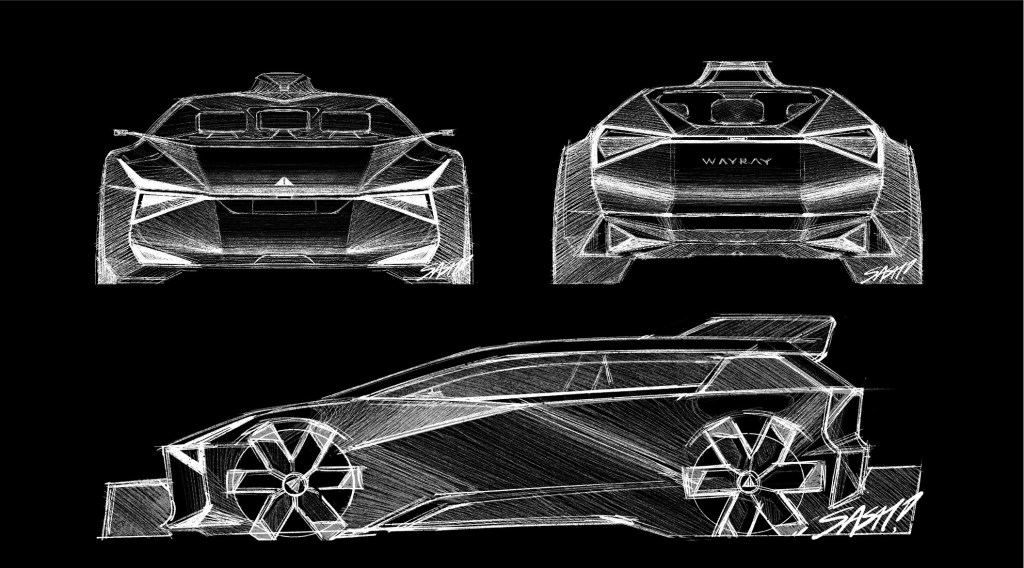
Sketches of the Holograktor's exterior design (Photo: WayRay)The triangular theme is integrated everywhere, from the 22-inch wheels to the laser headlights and taillights and even to the shrink-wrapped form of the roof Shrimp itself. While the front doors of the WayRay Holograktor car open conventionally with a slight upward angle, the rear doors contain an integrated B-pillar and open rearwards and upwards, providing the easiest access to all three seats. Part of the roof is integrated into the rear doors, giving rear-seat passengers an even easier way to step in and out. Selipanov’s design credits include works on the Lamborghini Huracán, the Genesis Essentia, the Bugatti Chiron and the Koenigsegg Gemera. The Georgian native, who grew up in Moscow and was trained at the prestigious ArtCenter College of Design in Pasadena before being snapped up by the Volkswagen Group, even came to work on the Holograktor car in an appropriately modern way — via an Instagram message. “I saw a message from Vitaly on Instagram in my inbox that said ‘Hey! Would you like to catch up and brainstorm about a potential collaboration?’” he admitted. “Outside of being obsessed with sports cars, I’m a science geek and a bit of a physics nerd, and the fact that his company was playing around with deep-tech ideas and bringing them to customers around the world was hugely exciting. “I thought that as far as non-lap-time-setting cars were concerned, this project was probably as exciting as I was ever going to find.”
The WayRay True AR® Display
The Deep Reality Display® technology results from years of extensive research by WayRay and consists of four essential elements. A compact laser unit, which can be integrated into the vehicle floor or other locations, generates a red-green-blue (RGB) light beam. This beam is transmitted through a special optical fiber to the picture generating unit (PGU) in the dashboard. The PGU is the second unique element and is equipped with a groundbreaking optical system. It has a much smaller volume than other technologies and will fit into any vehicle that runs a contemporary HUD, with gloveboxes of space to spare. Over the course of its development, the PGU volume has been decreased to less than three liters. The latest conventional HUDs take up more than 20 liters of installation space in a vehicle dashboard. This alone is a huge improvement in an area of the vehicle where literally every cubic centimeter counts and could even see dashboards reduce in size and weight in years to come. In addition, the Deep Reality Display® technology provides a significantly larger field of view (FOV). The first True AR™ HUD can be displayed in an area of up to 25 by 8 degrees (measured from the viewer’s eye). This is four times the field of view delivered by conventional top-end HUDs.
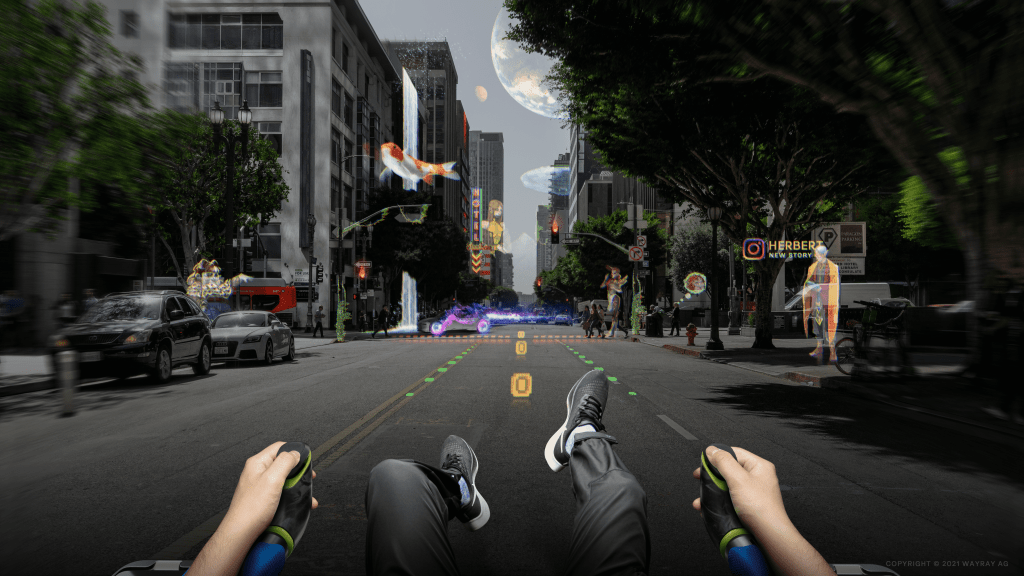
A new form of HUD technology envisioned by WayRay (Photo: WayRay)Perfect Positioning of Virtual Elements Enables True Augmentation of Reality
WayRay’s ultra-compact display also enables fully flexible positioning of the information or virtual elements. The information is not displayed at a fixed distance, and it is not floating between two and seven meters in front of the driver, as with conventional HUDs. Instead, the information can be virtually displayed anywhere between zero and infinity. This is the only way that relevant information about the real world can truly be incorporated seamlessly. Technically, it works like this: the light beam passes through the picture generating unit and hits the holographic optical element in the windshield. Unlike conventional HUDs, which work with mirrors, this also makes the WayRay True AR® technology immune to strong sunlight, thus ensuring that the PGU cannot be damaged by heat exposure.
Holographic Windshield as Another Game Changer
The holographic windshield, the third element, is another key component of the Deep Reality Display® system. It consists of holographic optical elements recorded on a tailor-made photopolymer and secretive functional layers that meet all the legislative and automotive industry requirements for glazing.
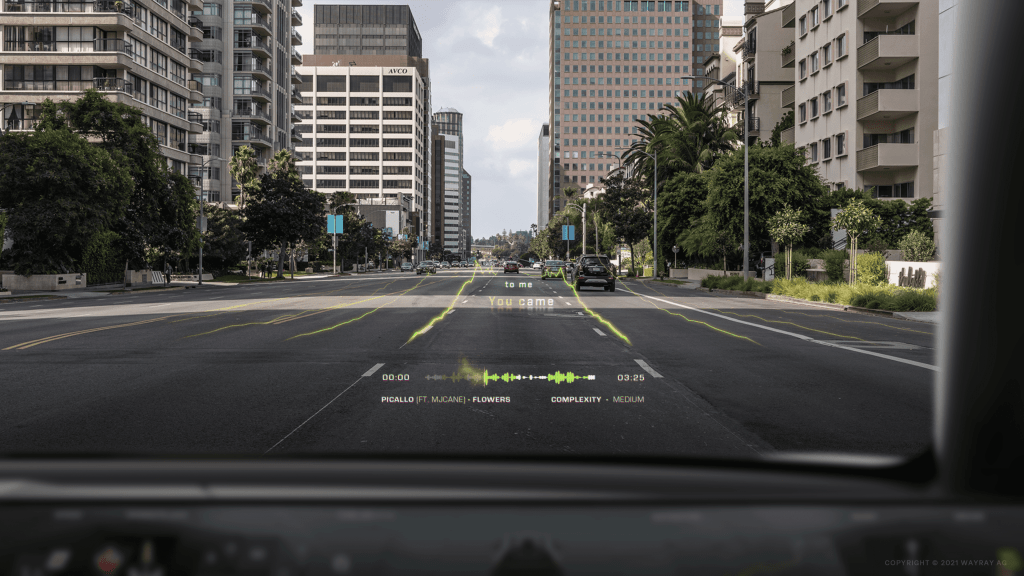
WayRay's holographic windshield for AR display (Photo:WayRay)This highly innovative and unique WayRay True AR® technology has been developed in close collaboration with international partners. To develop the transparent photopolymer film for the volume holographic optical elements (vHOEs), WayRay formed an exclusive partnership with one of the world’s leading suppliers of high-tech polymer materials, Covestro AG, a company based in Leverkusen, Germany. AGP eGlass, a global leader in the development and manufacture of high-tech automotive glazing that’s based in Ghent, Belgium, is responsible for integrating this special thin vHOE layer into the windshield lamination.
Self-Developed AR Rendering Engine
The fourth and equally crucial element of WayRay True AR® technology is its proprietary AR Rendering Engine, or ARRE for short. It processes data from sensors, cameras, and map information to precisely calculate the vehicle’s position and renders virtual objects in real time. Without this, it would not be able to achieve the perfect fusion of real and virtual objects. The driver can concentrate even better on the road thanks to this advanced driver assistance system and Deep Reality Display® technology. Virtual objects are displayed exactly where they belong. This also prevents drivers from having to constantly readjust their focus to perceive the kind of information carmakers typically display in the driver’s near-field on the instrument panel. The infinity focus maximizes safety by ensuring that the driver’s attention is always focused on the real world. With WayRay’s intuitive driver support, augmentations are embedded into the real world in such a way that the driver immediately understands where his attention is required and why.
Safety at the Highest Level
The system also ensures that the driver is shown only selected True AR™ apps that are most appropriate for the given traffic situation and context. When it is safe or when the vehicle is stationary, the Deep Reality Display® system can also show them content related to travel or the environment or entertainment apps. It also offers significantly improved in-vehicle entertainment options for passengers, allowing for an unprecedented level of immersion in games and even turning passengers into virtual characters that interact perfectly with the digitally augmented real world. WayRay is developing a software development kit (SDK) and its own True AR™ app marketplace, enabling third party developers to provide passengers with a variety of games and information, as well as entertainment applications in the future.
About WayRay
WayRay® is a team of deep-tech pioneers, creators of the world’s #1 Deep Reality Display® system—a new generation of the WayRay True AR® HUD—that can be integrated into any vehicle.
WayRay is a vertically integrated company that creates its products in-house, allowing for total control over the development and production process, cost reduction, and improved efficiency. WayRay is creating technological innovations that are unique and ahead of their time, nurtured in a special deep tech work culture that sets us apart from the rest.
Media contact: pr@wayray.com


 EV Cartel
Leave a comment